Showing posts with label Anecdote. Show all posts

Tuesday, December 21, 2010

Old Friends


Last week my High School drama teacher visited me here in Chicago. Beyond the fun of seeing her and catching up on our lives, it was really a wonderful moment for me to think about all the experiences I had that lead me to where I am at this point in my life. And I'm not being overly sentimental here or mushy. I'm taking a quiet introspective look at some of my formative years and giving thanks for the opportunities I had. Of course at the time they didn't seem good enough - nor would they have been enough to sustain me through my life. I had to move away and blaze my own path for my life. But there were hundreds of little things and thousands of tiny moments that I would never remember unless I sat down and actively thought about them. I'm glad that I had the cause to have that sit down.

Often times it is said in literature and witticisms that things are never as good as they seem. For me, this was a time of finally understanding that they were. I was always dreaming of bigger and better things. But it took some living and some real life experience to learn that things are not really bigger or better - they are just how they are. And it is never settling to be happy in the here and now. Not that one should ever give up dreaming, but the hope of the dream should not overshadow our waking hours.

Wednesday, November 17, 2010

Storm Upon the Heath


Blow, winds, and crack your cheeks! rage! blow!
You cataracts and hurricanoes, spout
Till you have drench'd our steeples, drown'd the cocks!
You sulphurous and thought-executing fires,
Vaunt-couriers to oak-cleaving thunderbolts,
Singe my white head! And thou, all-shaking thunder,
Smite flat the thick rotundity o' the world!
Crack nature's moulds, an germens spill at once,
That make ingrateful man!


On out last day in Ireland, my wife and I took a day tour into the country side. Several of the stops were overlooking lakes or waterfalls up in the mountains. While the sights were stunning, even more special was the pouring rain. Most people would be disappointed to have their tour ruined by freezing rain. But being up on the mountain side in a storm and surrounded by heather could only call to mind King Lear on the heath.

While an Irish mountain might not be the same as an English heath, the memory of standing in the rain and feeling just a little of what Lear felt will stay with me forever. And be an inspiration for the next dime I work on King Lear.


Happy Birthday:
Lorne Michaels (b. 1944)

Friday, September 10, 2010

Play of the Week: Antony and Cleopatra

Shakespeare's Antony and Cleopatra is so much more than an intrigue story of the Queen of Egypt. It's about two great lovers who have reached middle age and are still bickering as though they were teenagers. Their struggle puts Romeo and Juliet's fling to shame. Their love transcends nations and continents. Betrayal here isn't told through glances and liaisons, but through armies and passion greater than words. It truly is a story of life and death.

And when the plot turns to the misguided message that will lead to Antony's death (much like Romeo) because he thinks his lover has died, he misses his grand statement and actually botches his suicide. It's because he's human. Romeo and Juliet are the stuff of passionate poetry and tragedy that can be tied up neatly with a little bow. This is the stuff of real life and shows us the shortcomings that we see and accept, if we life long enough to experience them.

This play will never reach the fame that Romeo and Juliet has. But then again, Romeo and Juliet has become so idealized that few of us even remember that the two lovers die in the end. Antony and Cleopatra do not have the poetry that our two young star-crossed lovers had. But then again few of us do.

I had the pleasure to work on a production of Antony and Cleopatra a few years ago that took a lot of liberties with the script. I enjoyed them, but I could see how some people wouldn't. The one gesture that really resonated, however, was the staging of Cleopatra's suicide. It's quite a grand statement to kill yourself through willingly inflicted asp bites and quite difficult to stage effectively - let alone to make it seem anything less than a ridiculous spectacle that will completely take the audience out of the scene. But when our director/adapter brilliantly choose to use syringes of lethal poison and call them "worm" or "asp," everyone got the point and the effect was quite powerful.

Read this play again with the new idea of a middle age love story and then with the new gesture in the end - I think you'll quite enjoy it.


Happy Birthday:
Franz Werfel (1890-1945)

September 11:
Rainis (1865-1929) and Jennifer Tipton (born 1937)

September 12:
Sir Ian Holm (b. 1931)

Wednesday, September 1, 2010

How can theatre be postdramatic?

A couple weeks ago I was sitting in a cafe having my lunch and reading Hans-Thies Lehmann's Postdramatic Theatre. I won't even spoil the thesis for you - you must read this yourself (and I highly recommend it).

The point of this story is that my waiter approached me an asked "how can theater be post-dramatic?"

A very good question whether you are a theater insider or not. I explained to him that theater has moved beyond the need for linear or "fabel" stories within the frame of realism. That characters are not so much people as they are symbols or signifiers. That the text may or may not be liner dialogue. Not saying there is no such thing as plot anymore - but it's not necessarily the focus.

At this point my waiter simply rolled his eyes and asked: "Are you a grad-student?"


Happy Birthday:
Ned Allyen (1566-1626)

Monday, August 30, 2010

Kevin's Story

Kevin is cast as Will Parker at a regional theater production of Oklahoma. He is the youngest person in a veteran cast. The actor playing Curley has played the role six times. The woman cast as Laurie just closed a show on Broadway. While Kevin has gotten work in several national tours, this is the first time he has landed a role that isn’t in the chorus and would be considered one of the principals. Better yet, the director seemed to cast him because of his potential and has mentioned both at casting and callbacks that he is looking forward to helping Kevin develop the character.

Heading into the two-week rehearsal process, Kevin is excited to play Will Parker and have the opportunity to explore the role and grow as an actor.

Unfortunately the director has terminal cancer and has to miss the majority of the rehearsals. While he remains billed as the director, a second director is hired to facilitate the process – a director who, though Kevin has worked with on several occasions, is one of those directors who will simply pull out his Oklahoma binder and proceeded to block the show he’s already directed eight times.

The new director is one of those directors who gives very precise blocking and accepts very little collaboration from his actors. Pretty soon Kevin began to feel very limited and constrained by the process. He is having a harder time too than some of the other actors who have already played their roles several times. Kevin begins to doubt his abilities and whether or not he should have been cast in this role, let alone this show.

As a result, this was Kevin's last show. He has left theater and become an engineer. And although this may be an extreme example, how often do we as theater artists and artists in general experience this type of toxic environment that makes us question the relevance and ability to fulfill of our art?

Thursday, August 26, 2010

Theater is a Hobby?

I remember once taking a friend of my wife's to see one of my friends productions in the city. It was the first time I had really met her and I'm sitting there with her and my wife talking about what I do. The funny thing about this particular friend is that she was born and raised in Russia before coming over to the U.S. several years ago. And while she's fluent in English, some of the nuances don't always come across and she can appear blunt - blunter than she ever means to be.

So I'm sitting there telling her about how I work a day job and then run around like crazy at night going to meeting and rehearsals. She asks about pay and I tell her that at this point in my career I'm doing it more for the fulfillment rather than employment and that most of the actors in the show we are seeing tonight are operating under the same circumstances. This is when she said something that just floored me.

"Oh. This sounds like a very nice hobby."

A hobby!?! I thought to myself, this is not a hobby - this is what I do. This is how the theater scene works and maybe someday I will be paid for it. But the more and more I thought about it, her choice of the word hobby is very accurate. It's something I do in my spare time that provides enjoyment rather than income.

Thinking about most semi-professional - if not professional - theater in these terms really can make you question why we allow ourselves to do this and if we are dwelling in an illusion. The Guardian has an interesting discussion of this very topic in their blog this morning. Take a look over there and think about what it is we do as theater artists.

Tuesday, June 22, 2010

Knit Happens

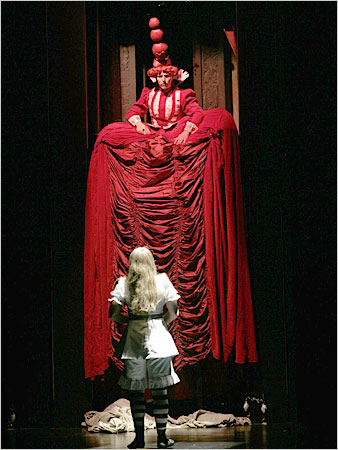
One of Chicago's beloved productions opens this week for yet another run. Lookingglass Alice, Lookingglass Theatre's original and signature piece, returns from tours to play the performance space at the Water Tower. Make it's third appearance in this show is a 30 foot long white scarf knitted especially for the production.

Alice when first arriving in Wonderland is greeted by a immensely sized White Queen knitting a very long garment which will appear later as a baby blanket for the character grows younger, not older. The piece was commissioned for the production by Props Designer Joe Schneider and created by Mary Cotter in 2007. The craftsmanship was so good that the prop continues to be used in the production. The piece employs over $80 worth of yarn and took nearly a month to construct.

(The character pictured here is the Red Queen - though not knitting, she is similarly sized to the Red Queen)

Wednesday, June 9, 2010

More Fish

Many times directors give notes that are entirely undiscerning or unplayable. Directors are thinking about the play differently than the actors, stage manager or designer - they are seeing the whole picture. And sometimes this translates to getting a note that refers to something that the actor knows nothing about. Or it could be that the director gives a note that is really a signifier or a metaphor and not a real action or emotion that an actor can play. Sometimes the director is second guessing his or herself. Sometimes that person just doesn't know what they are talking about. Many times, they are responding to what they have just seen before them, having a very strong emotional or intellectual response, but haven't had time to really sort through their thoughts so that what comes out of their mouth is a complete mish-mosh of words and ideas.

I am as guilty of this as anyone - more so at times.

The trick is not to take yourself too seriously and really take the time to stop and listed to an actor's question if they need clarification. Take a moment to get your thoughts together before you speak.

Humor also helps. Making fun or yourself makes the actors know that you are not being too pretentious and expecting them to understand every single world that flops out of your mouth (an subsequently dies).

One of my favorite notes to give in this case is "the scene needs more FISH." It's a joke me and a buddy have. We both know it means nothing and soon the cast realizes this (though they are often confused at first). But the more it is used throughout the process, the more it helps as a stress relief later.

There is another actor, who is a very close friend of mine, who I will often give then note "could you please suck less" or "just take the suck out." I know I can give the note to him because not only is he a competent actor who is very much on top of his process, he is also a confident person and can take the joke (and he knows that I am only joking). I would never do this to an actor who was less confident or struggling in their role.

Just some rehearsal room humor to keep the mood light and to let them know that their director doesn't care if you make fun of him too.


Happy Birthday:
John Howard Payne (1791-1852)
J.M. Barrie (1860-1937)
Cole Porter (1891-1964)
George Axelrod (1922-2003)

Wednesday, May 19, 2010

How we learn and how we get the grade

Rating, reviewing and grading the arts is a very subjective thing. Most of the time, as in reviews, we realize that the evaluation is an opinion and that we can choose to agree or disagree. What happens, however, when the evaluation is the most important thing and actually has bearing? In this case I am talking about an academic setting.

This story comes from a close friend of mine’s student teaching days.

He was first year scenic design at a rather prestigious private institution. At this particular school, the majority of the theatre department was made up of performance majors – or as we like to call them actors. There was a requirement for two production/design classes so every first year design class was bound to have its fair number of actors along side the dedicated designers. These actors, as you guessed it, were taking the class just to fulfill the requirement so they could graduate and wanting to do the bare minimum requirements so they could go off and star in that semester’s mainstage.

This particular class was an unusually unmotivated group and kept asking the professor how he was going to grade the final project – which was a fully realized model set.

Our friend finally go so fed up with his group that he told them that he would be grading the models on how far he could throw them. Whose ever flew the farthest would receive an “A” and the scale would go downward from there.


Happy Birthday: Lorraine Hansberry (1930-1965)

Tuesday, May 18, 2010

This isn't the theater...

I head this story from a patron who was seated next to me at a show last weekend. I didn't catch the young man's name; I hope he doesn't mind that I'm sharing.

So he was there that evening to see a work friend of his performing in the show. He told the story how he had gone to see another show put on by this same friend back in February. The patron had, as many patrons do, gone out to dinner before the show and had a few drinks before making his way to the theater. This theater was located inside of a church - as so many theaters in Chicago are. Once inside the building, the patron wasn't quite sure where to go. He eventually found a large room where a group of people were congregating among folding chairs.

He found it a little strange, but his friend had warned him that the theater was a little smaller and a little rag-tag. So he sat down. After a few moments he noticed that there was punch and cookies available and as nice as that seemed, something didn't seem right...

He looked around and really paid attention to the other people waiting for the performance. And once he put two and two together he realized that he wasn't attending a theatrical performance but was instead sitting in on an AA meeting. He quickly stood up and excused himself from the room. The theater was on the second floor of the church - luckily the show was really good.


Just a little cautionary tale for all of us attending shows in Off-Loop performance spaces.


Happy Birthday: Lorraine Hansberry (1930-1965)

Wednesday, November 4, 2009

What is Theatre

Don't cringe. This isn't too philosophical a question as you might expect. Thanks to Thomas Cott, we have many more articles how theatre should be viewed in the lens of not-for-profit institutions. Should it be on par with charities, hospitals, homeless shelters, and educational institutions? Can you really make the same case for fundraising as you would for a new children's hospital?

And if theatre doesn't fit into this traditional model, then what? No mid-sized theatre can meet its budget on tickets sales alone - or can it? Broadway is based on ticket sales, but our regional theatres with their season-based-subscriptions don't have the same profit model. So how do theatres support themselves then? One idea is a community support system. Think of it as a community garden that a community will invest in at the beginning of the growning season and reap the benefits at the harvest.

What other ways might theatre not only define itself and it's value to the community, but also raise those increasingly difficult to find funds that it needs to survive? Is turning theatre to a for profit model a better idea? If theatre is a charity, who is it serving if not everyone can afford to purchase seat - and what is the mission that it is trying to accomplish to leave the community a better place?

Friday, October 23, 2009

Chicago Theatre on a Rainy Night

I am going to break with the Play-of-the-Week to tell the story of my night last night. I was sitting in a coffee shop downtown killing time before going to see Steve Martin play his banjo at the Cadillac Palace Theatre when my fiancee interrupted my reading. There at the counter, waiting for his coffee was Nathan Lane looking very handsome in his Gomez Adams moustache.

I am going to take this opportunity to publicly apologize to Mr. Lane for staring, which I did. I obviously made you uncomfortable. So please accept my sincerest apology.


Steve Martin was quite lovely in concert. A huge thanks to Broadway in Chicago for bringing him out for us. It is so lovely to see someone doing something they truly love. We see all the time people who have made their careers and their name doing something they love, but rarely do we see someone who has already succeeded doing something else, be able to take up their second love. Bravo.

One note, however, the lights were awful. Really, really awful. I hope that the regular board operator was out sick or something, because the performance of Steve Martin and the Foggy Canyon Rangers deserved better.


Happy Birthday (October 24): Moss Hart (1904-1961) & F. Murray Abraham (b. 1936)
October 25th: Pablo Picasso (1881-1973)

Wednesday, September 30, 2009

Creative Process

Normally the design process for Off-Loop theatre goes something like this. Hire a scenic designer at the last possible moment, she or he has a few brief meetings with the director to discuss vision, and there are some drawings or a white model ready for the first production meeting. The process usually works out well and everyone is generally happy.

Once, however, the scenic designer walked into the first production meeting with a full 1/2" color model; all done and beautifully painted. The designer obviously had spent a lot of time working on it and built it to perfections. The director was so surprised he didn't know what to say - that the model became the final design and that was the end of the discussion.

What the director didn't know what this is simply how the designer "thinks." Where other designers might do some basic drawings, show research, or have a conversation with you, this particular one builds models - and very good ones at that. The model was just the literal expression of his initial idea. He would have been happy to have gone back and build a second, third, fourth, or fifth just to work through the process. But the director was so shocked to see what he thought was a finished design that he didn't offer any feedback at all.

Just remember that theatre is a collaborative art. Every element is just as important as another. As long as budget and time don't get in your way, take the time to explore all possibilities with your team of artists before setting on the final way of telling your story. You never know what may surprise you.

Tuesday, September 15, 2009

I Am I Donkey Hoti

Once upon the time there was a little boy whose father loved the musical Man of LaMancha and this love rubbed off on the three-year-old. So much so, in fact, that the little boy would ask his parents to turn on the LP and sit down on the couch. The little boy would provide them with a paper-towel roll that to him was a telescope. And then he would set the scene - or rather the voice of Richard Kiley would. And as Cervantes transformed into his knight, the child would pop-up from behind the arm chair brandishing his wooden "Robin Hood" sword astride his stick-horse stallion and charged into the arena as the dauntless knight, Donkey Hoti.


Happy Birthday: Agatha Christie (1890-1976)

Tuesday, September 8, 2009

First Broadway Show

Seeing your first Broadway show is something very special. It happened to me the very first day I stayed in New York. We checked into the hotel and after deciding that seeing the Empire State Building from the outside was enough we wandered around until we eventually found ourselves in Time Square. Not having very much money we tried to score rush tickets. Being in our mid-twenties, we weren't having very much luck. Every ticket window we went to was the same routine:

"Do you have any rush tickets?"
"We have student rush tickets. Do you have a student ID?"


Unfortunately for us we didn't.

We thought we would try one last time before we gave up and decided to find other plans for the evening. We went to the box office of the show my date really wanted to see. After standing in line, I approached the agent.

"Do you have any rush tickets?"
"I have student rush tickets."


Not wanting to waste his time, I said "oh well, I don't have a student ID."

But he wasn't done.

"I can put you in row four. Two tickets for $120 together."


He must not have been listening to me. He'd quoted me the student price. So I was about to repeat what I just said when I got it.

"We'll take those. And thank you so very much!"
"Everyone gets a break,"
he said. "Everyone gets one."

Tuesday, September 1, 2009

Try to Remember the Kind of September

Once again summer has flown by and we are all facing that wonderful month of September. It is a month of beginnings. School is beginning again. The theatre seasons in Chicago are all starting over. The weather is changing greeting us with an early autumn crispness that seems to have been the theme for the summer itself in Chicago.

Ghostlight has been a little lax as my day-job has moved to new offices and I have been in charge of managing that move. One of my co-workers who once-upon-a-time spent time in the theatre asked me if I had ever been a Stage Manager. The theatre truly influences all aspects of our lives and can be seen by those we com in contact with.

This new season will be a challenging one for theatres across the country. While the economy has felt the effects of the recession for over a year now, the charitable world has not yet. Giving cycles are a year behind and as theatres start to apply for new grants and donations they will find that budgets have been slashed in this fiscal year. The weather is not the only thing that has been cold.

But we need to stand up and continue to create our great art. Creativity spans far beyond the ability to spend a large budget well. The main spark of creation is being able to create something out of nothing. That is the challenge - to move the spirit and the spirit alone. Examine the story you are telling, strip away everything but the essentials and I guarantee you that you will survive the new season.


Happy Birthday: Ned Allyen (1566-1626)

Tuesday, August 25, 2009

Mary Zimmerman's Odyssey

One of the most defining moments in my theatrical development was the first time I saw a Mary Zimmerman production. It was the third show I'd seen in Chicago (Forever Plaid and 2nd City being the first two) and the first show at the Goodman Theatre. I got lucky and received tickets in the first row of the Goodman's old space by the Art Institute. I never had seen anything like it.

The sweeping spectacle of very simple images made a huge and visceral impact on me. The first image of a child reading a book downstage and a muse emerging from behind the raked stage at the very upstage most point was so stunning. Watching the body move from far away and enter into the same space with us was like watching a figure step out of a forced perspective drawing. I'd not seen anything like it.

Zimmerman's bread and butter is creative staging. Ten years later some of her tricks that elicited gasps of awe from me are old hat now. But the immediacy of her work is still effective and affecting. She makes us aware that we are only sitting in a theatre - she doesn't try to mask the magic of the theatre. But by laying the "theatre" out there in front of us and exposing the device behind the illusion, it somehow makes the trick so much more effective.

Wednesday, August 19, 2009

Proof Read Everything

It was my first big directing gig in college. I was very excited. I had just sat through three days of auditions for Romeo and Juliet and I was getting ready to post my call-back list. The unseasoned director in me wanted to make sure that I didn't hurt anyone's feelings by not calling them back so I wrote what I felt was a very nice note. I handed what I wrote to my Artistic Director. He read it and literally fell over laughing.

Apparent in my excitement, I didn't fully convey what I had intended:
Thank you to all who auditioned. As director say, t was a difficult decicion, espcically since I had to select four women's roles from forty people give you some idea. Thank you for coming out.


This proves two things. 1) Proof read everything before you make it public. 2) And never apologize for your casting "decicions."

Tuesday, July 28, 2009

Learning Your Lines

It is one of the greatest challenges for an actor: learning all your lines. Whether you are Hamlet and just will not shut up or second spear carrier from the left, you need to be 100% secure in your memorization or else the rest of the production will suffer. If your scene partner doesn't have confidence in you to know the correct line, it can feel like performing the high-wire without a net.

So what do you do when you can't seem to commit your text to memory. Many actors have found creative different ways to find aids for themselves wherever they can create them.

All of us have been lazy and rather than memorizing a letter read on stage have relied on the prop having the accurate text printed on it. No we all know the danger is the prop is misplaced and the unsuspecting actor opens the prop and is in a whole world of trouble.

My high school drama teacher proudly told us of his senior play where he had to tape the lines to a scene on a pizza box because he hadn't bothered to learn them. I know of another high school production where the young man playing Danny in Grease seemed to play the drive in movie scene very nervous and quite as any teenager would behave on a date. When complimented on his performance, however, he confessed that he kept looking away from his scene partner because he was reading his lines off the dash board.

You could also embrace your mental relapses. There is a community theatre production that I recall fondly where the young man playing Motel the tailor in Fiddler on the Roof, during his solo Miracles of Miracles jumped up and instead of singing the next line, exclaimed "I forgot my line!"

So share with us any clever tricks you've used to slip your lines into the actual production because you didn't do the best job you could have at your memorization.

Tuesday, July 21, 2009

The Curse of Mackers

Anyone who has worked in the theatre knows of the curse. It is bad luck to say the name of the Scottish Play in a theatre. There are various ways of absolving yourself of any slip of the lip: spit and swear or leave the theatre building and twirling 'round three times.

So where does this curse come from? There is a whole history of bad events supposedly surrounding this play. The play itself is bloody, murderous, and violent requiring many fights and loads of special effects. This increases the chances of things going wrong. But in a more fantastical sense, there are legends of Shakespeare quoting actual black-magic incantations in the play or deals made with witches to unlock some darker purposes.

In reality, this is simply one of those good natured traditions of the theatre that create great stories. And while you will come across an actor here or there who devoutly believes in the curse, most take it with a grain of salt. There is some fun in spitting and swearing or paying great attention not to mention the name of the Scottish King.

Please share with us any stories you have of haunting or misfortune concerning the utterance of Mackers or around any performances of the Scottish Play.


Happy Birthday: Ernest Hemingway (1899-1961)